Royal status
Her First Werewolf (BBW, Werewolf, Prince Charming, Fairy Tale Romance)Royal status is the concealed social position that changes the meaning of Charles’s appearance, courtship, and proposal. Although Flora first encounters him as an unusually refined stranger and later discovers that he is a werewolf, his declaration that he belongs to a castle in Endenbrook reveals an additional identity: he is a member of a royal family. This status makes his offer of marriage not merely a private romance but also a passage across the class boundary that has shaped Flora’s family history.
Discovery and Social Position
Flora’s life begins far below the level associated with royal privilege. After her father’s death, she works on the family farm, milking cows, cleaning stalls, and helping Hans, while Morgan grows increasingly worn down by labor and time. Flora fears inheriting the same restricted existence and longs for a different life from that of a farmer’s daughter. Her father’s background makes this longing especially pointed: he came from a wealthy family, yet married Morgan despite objections that she was socially inferior. Their marriage therefore establishes love as a force capable of crossing class distinctions, even as the surrounding community continues to measure wealth and marriageability against one another.
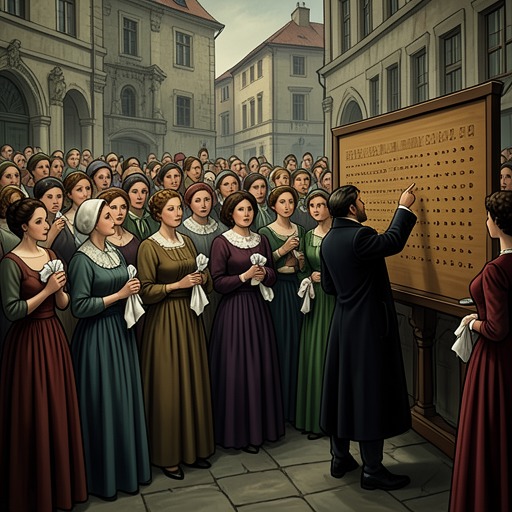
Morgan tries to redirect Flora toward a socially advantageous marriage. She insists that Flora should become settled and “married well,” and points to a distinguished visitor expected at the town-hall party: a well-off farmer accompanied by a former serviceman with connections to important people. The proposed match reflects a marriage market in which occupation, wealth, military service, and reputation operate as signals of eligibility. Flora resists this arrangement because she values freedom, reading, and the ability to think for herself, but the pressure reveals how strongly her unmarried status limits the choices her mother believes are available.
Charles’s Hidden Rank
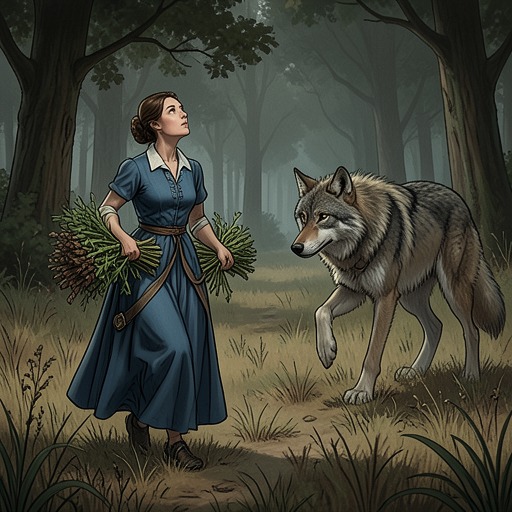
When Flora meets Charles in the forest, his fine, clean clothes, broad shoulders, smooth skin, and polished appearance already distinguish him from the farmers and herdsmen she knows. His appearance offers an early social clue, although Flora initially reads him chiefly as a handsome and unsettling stranger. The later revelation of his supernatural identity intensifies the contrast between appearance and status: the man who becomes a large black wolf is also the man who possesses a castle and belongs to a ruling family.
Charles identifies Endenbrook as the location of his castle and explains that he is not first in line to inherit. Six older brothers and their families stand ahead of him, so he would become king only if all of them died. His position is therefore royal without being immediately sovereign. He belongs to the privileged family structure but occupies a marginal place within it, describing himself as a “black sheep.” Flora answers by turning the family metaphor into a joke about a “black wolf,” linking his social outsiderhood to his werewolf form rather than treating either as grounds for rejection.
Rank, Affliction, and Marital Choice
Charles’s royal status is inseparable from the “affliction” that separates him from the direct succession. He tells Flora that his condition gives him considerable freedom because his father has allowed him to choose whom he will marry. The statement reverses the usual logic of arranged or socially regulated marriage: his rank could have made him subject to dynastic expectations, yet his unusual condition grants him an exceptional degree of personal choice.
This freedom allows Charles to propose suddenly after revealing his identity. The proposal joins emotional declaration, bodily intimacy, supernatural disclosure, and social elevation in a single movement. Flora has only recently learned that Charles is a werewolf, but she accepts his promise of care and says that she feels as though she has known him all her life. Her response presents the royal marriage as an alternative to the future Morgan has tried to arrange, though it does not erase the pressures that made marriage such a contested issue for Flora in the first place.
The Castle as an Escape
Charles frames royal status as an avenue out of Flora’s exhausting rural life. He says that he wants to take her away from the farm and offers his castle in Endenbrook as their destination. The proposed move answers Flora’s long-standing desire for a different existence from Morgan’s: instead of remaining tied to milking cows and fieldwork, she could enter a household associated with wealth, lineage, and power.
The offer also extends beyond Flora alone. When she asks whether her family may come to the castle, Charles agrees without qualification, promising that anyone she wants may accompany her and that the world is hers to choose. His answer makes royal privilege appear transferable through marriage and presents the castle not only as a romantic refuge but as a resource capable of protecting and relocating Flora’s family. In contrast with Morgan’s immediate concern that Flora secure a respectable husband, Charles offers an expansive version of marriage in which social advancement, emotional attachment, and family security converge.
Narrative Significance
Royal status complicates the story’s apparent movement from peasant hardship to fairy-tale rescue. Flora does not receive a white knight; she receives a werewolf who is nevertheless connected to a castle, a royal father, and a large family hierarchy. The contrast turns conventional class imagery inside out: Charles’s animal nature marks him as frightening and shameful, while his lineage makes him desirable within the social order that Morgan wants Flora to enter.
For Flora, the revelation changes the scale of her possible future. She began as a farm laborer resisting a marriage selected through local gossip and class calculation. She ends the available narrative accepting Charles’s proposal and imagining access to Endenbrook, royal family life, and a freely chosen relationship. Royal status thus functions less as a fixed political office than as a narrative mechanism of transformation: it converts a feared outsider into a powerful marriage partner and makes Flora’s escape from farm life appear both emotionally chosen and socially consequential.